
Amunet: Amunet is a primordial goddess from ancient Egyptian religion, known as 'The Hidden One'.
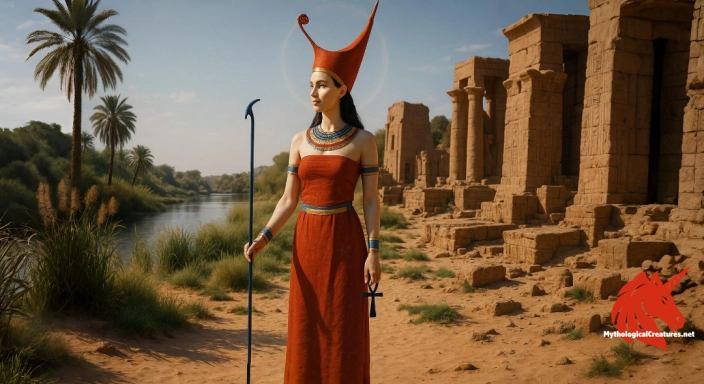
Amunet
Amunet - One of the earliest attested deities, Amunet embodies the mystery of hidden creation and the unseen forces of the cosmos
Origins & First Encounters
Amunet is a primordial goddess whose very name, meaning 'The Hidden One', evokes the mysterious depths of ancient Egyptian cosmology. Her origins are traced back to the earliest phases of Egyptian religious thought, where she embodied the ineffable forces preceding creation. Emerging in a pantheon where abstract concepts were personified, she was paired with her masculine counterpart, Amun, together symbolising the duality of creative power. This divine pair was considered to exist before the unfolding of the cosmos, alongside other sacred couples representing the primeval elements. The centre of her worship was in Thebes, a city that celebrated her enigmatic presence well into the era of the Ptolemaic Kingdom. The continuation of her cult during the final dynastic periods underscores the lasting impact of her symbolism. Her mythic narrative reflects not only a religious devotion to unseen forces but also a deep philosophical pondering on the nature of existence and concealment. As a goddess of the hidden, Amunet embodied themes of mystery and the unknowable, ultimately inspiring both ancient rituals and enduring cultural fascination.
Source Texts & Tale Variants
The earliest inscriptions and religious texts of Egypt provide the primary attestations of Amunet's divine presence. These ancient documents, inscribed on temple walls and in ritual texts, highlight her role as a foundational deity in the pantheon of creation. She appears in several cosmogonic narratives that combine myth and mysticism, often in tandem with her male counterpart Amun. Variations in these texts suggest that her attributes were subject to reinterpretation as the religious landscape evolved over the centuries. Despite the fragmentary nature of some records, the continued mention of her in various temple rituals underscores her authenticity in the mythological canon. Worship practices documented in later periods also incorporated hymns and prayers invoking her enigmatic character. Manuscripts and inscriptions from Thebes, in particular, provide a rich but scattered set of references that illustrate her revered position among other deities. The multiplicity of texts, coupled with evolving interpretations by priestly classes, reflects a dynamic narrative that has been revisited and reimagined over time. The interplay between older religious traditions and reinterpretations in subsequent periods creates a rich tapestry of accounts, each adding depth to her legendary persona. This enduring presence in ancient documents not only cements her status as a primordial force but also invites ongoing exploration into the layers of her myth.
Form & Powers
Unlike later deities with fixed iconographies, Amunet’s physical portrayal is veiled in a deliberate ambiguity that mirrors her mysterious nature. Artistic representations from ancient Egypt often depict her with an ethereal grace, cloaked in flowing garments symbolic of the unseen. Although few statuary examples can be definitively identified as Amunet, artistic conventions suggest an elongated, graceful figure that blends seamlessly with the cosmos. Her visage is sometimes hinted at by a partially veiled face, suggesting that her true essence remains concealed from mortal sight. The subtle artistry employed in her depictions underscores a sense of quiet power and restrained beauty. In several reliefs, the drapery and contours evoke both movement and stillness, as if capturing the transient moment between concealment and revelation. Her form is rendered in a manner that emphasises the abstract qualities of mystery and the ineffable nature of creation. Variations in the visual details, such as the use of delicate lines and soft shading, enhance the aura of transcendence that surrounds her. This elusive physicality reinforces her role as a guardian of hidden wisdom, an aspect that has captivated viewers through the ages. The lack of a rigid physical standard invites interpretation, making every subtle artistic touch a deliberate symbol of her deeper spiritual significance.
Regional Faces
Regional worship of Amunet was particularly concentrated in Thebes, where local traditions elevated her enigmatic character within a broader religious framework. In Thebes, her cult intertwined with state-supported religious practices, allowing her mystique to permeate civic and spiritual life alike. Her influence extended beyond this urban centre, as diversified local interpretations in Upper Egypt accentuated her role as a deity of concealed power. With the extension of Egyptian culture into the Hellenistic realm during the Ptolemaic period, adaptations of her myth allowed for intriguing syncretisms with Greek religious ideas. Communities in different parts of Egypt reimagined her attributes, sometimes aligning her with regional symbols of the unseen and the mysterious. Local priesthoods would often incorporate her motifs into temple art and ritual recitations, ensuring that her essence resonated with the distinctive cultural flavours of each area. In some local traditions, nuanced differences in iconography emerged, reflecting adjustments to meet evolving religious and social contexts. Despite these regional variations, the core notion of a divine force dwelling in the hidden realms remained a unifying theme. Such adaptations across regions highlight the flexibility of Egyptian religious thought and the enduring appeal of Amunet’s mysterious persona. This regional diversity in worship illustrates a vibrant dialogue between central religious ideas and local interpretations over centuries.
Cultural Parallels
The enigmatic aura of Amunet invites comparisons with primordial deities across other ancient cultures, where divine mysteries often embody the unseen aspects of existence. Her intrinsic association with hidden forces finds echoes in figures such as the Greek primordial deities, whose own narratives of creation blend the visible with the mysterious. Like many ancient goddesses who personify elemental forces, Amunet reflects universal themes of duality and balance, akin to complementary pairs found in other mythic systems. The pairing of Amunet with Amun mirrors similar dualistic constructs that seek to reconcile contrasting forces within the cosmos. This motif of paired deities is a recurrent theme across civilizations, where the interplay of masculine and feminine principles facilitates the emergence of creation. Moreover, her subtle and elusive presence resonates with mythological figures whose power is derived from concealment rather than overt display, a concept evident in various cultural traditions. While many mythologies offer deities with clearly defined physical traits, Amunet’s abstraction allows her to join a broader pantheon of gods whose narratives are shrouded in mystery. The cross-cultural appeal of such hidden deities underscores a collective human penchant for exploring the enigmatic and unknowable aspects of life. By comparing her wide-ranging attributes with similar mythic figures, one can better appreciate the universality and adaptability of the symbolism surrounding primordial forces. This comparative analysis not only bridges cultural divides but also enriches our understanding of how ancient peoples conceptualised the forces behind creation.
Legacy & Modern Evolution
The evolution of Amunet’s myth from a nearly obscure primordial deity to an emblematic figure of hidden wisdom illustrates the fluid nature of mythological tradition over time. Initially worshipped as a foundational aspect of the Egyptian cosmos, her doctrines and iconography gradually merged with those of other celebrated deities during the Hellenistic and Roman epochs. As religious thought shifted over the centuries, her mysterious identity became a powerful symbol for the uncharted and intangible aspects of existence. In later eras, especially during the modern revival of interest in ancient spirituality, her elusive qualities have been reinterpreted to resonate with contemporary ideas of mystery and internal exploration. Artistic and literary representations have often drawn upon her image to evoke themes of secrecy, transformation, and the sublime power of the unseen. Modern neo-pagan movements and new age philosophies have also embraced her as an archetype of hidden strength and enduring enigma. The historical reinterpretation of her attributes reflects a dynamic conversation between ancient myth and modern symbolism, where the past continues to inform current spiritual and cultural narratives. Her enduring legacy is now studied not only as an element of Egyptian lore but as part of a universal framework that celebrates the unseen aspects of human experience. This continual reinvention in art, literature, and spiritual discourse testifies to her lasting influence and the timeless appeal of mystery. Amunet stands as a reminder that even the faintest threads of ancient myth can weave a rich tapestry of meaning in the modern world.
Interesting Fact
The name 'Amunet' literally means 'The Hidden One', reflecting the ancient Egyptian belief in a divine force that operates beyond human perception.
For indie creators
Give your myth project a permanent home
Indie authors, artists, small studios, and makers can secure an annual, non-intrusive sponsor slot that meets readers where they explore.
Obtain more informationQuick Creature Info
Origin:
Our Mythic Legendary Rating:

Also Sometimes Known As:
Habitat:
Supernatural Powers:
Physical Attributes:
Abilities:
Behavior:
Lore:
Related Creatures, Tales or Lore
- NNun (Egyptian primordial water goddess)
- NNun-t (primordial cosmic entity)
- AAtum (creator deity with similar primordial attributes)
References
Discover Another Mythical Legend You May Not Have Heard Of?
Uncover the mysteries of ancient folklore and expand your knowledge of legendary beings from cultures around the world.
Dare to Meet the Bobbi-Bobbi....
Curated by the Mythological Creatures Team
Series editor: Mythological Creatures Directory
Primary desk: Hellenic & Ancient Mediterranean Desk
(rev. November 2025)